Florence Apartment vs Hotel: Why a Private Apartment is the Smart Choice
Florence is one of those cities where your accommodation genuinely shapes your trip. Stay in a cookie-cutter hotel room and you'll experience Florence as a tourist. Stay in a private apartment in a real neighborhood and you'll experience it as something closer to a temporary resident — which is a fundamentally different (and better) thing.
This isn't a blanket anti-hotel argument. Hotels serve a purpose. But for Florence specifically, apartments have advantages that go beyond personal preference. Here's the honest breakdown.
The Cost Comparison: It's Not Even Close
Let's start with the numbers, because they matter.
A mid-range hotel in Florence's historic center costs €150-250/night for a standard double room. That gets you roughly 20-25 square meters, a bed, a bathroom, and maybe a minibar. Breakfast might be included, or it might be an extra €15-20 per person.
A well-located apartment near Santa Maria Novella station runs €100-160/night for 50-55 square meters. That's double the space for less money. But the real savings come from the kitchen.
The Kitchen Factor
Here's what most travelers don't calculate: dining out for every meal in Florence adds up fast.
- Breakfast at a café: €8-12 per person (cappuccino + cornetto + maybe a juice)
- Lunch at a trattoria: €15-25 per person
- Dinner at a restaurant: €25-45 per person
For a couple, that's €100-160 per day on food alone. Over a week, you're looking at €700-1,100 just on meals.
With an apartment kitchen, your numbers change dramatically:
- Breakfast at home: €2-4 per person (espresso from a moka pot, fresh pastries from the neighborhood bakery, fruit from the market)
- Pack a picnic lunch: €5-8 per person (bread, cheese, prosciutto, tomatoes from Mercato Centrale)
- Dinner out: €25-45 per person (you still eat out, but once a day instead of three times)
That brings your daily food cost down to €65-100 for two. Over a week, you save €250-400. That's essentially a free extra night or two in Florence.
Real Example: One Week in Florence
| Expense | Hotel | Apartment |
|---|---|---|
| Accommodation (7 nights) | €1,400 | €840 |
| Meals | €910 | €560 |
| Total | €2,310 | €1,400 |
The apartment option saves roughly €900 for a week. That's enough for a day trip to Cinque Terre, a wine tour in Chianti, and several museum tickets.
Space: The Underrated Luxury
A standard Florence hotel room is functional. A Florence apartment is liveable.
This distinction matters more than you think, especially for stays longer than two or three nights. In a hotel room, when you're not sleeping, you're either squeezed at a tiny desk or sitting on the bed. There's nowhere to spread out, nowhere to decompress after a long day of walking.
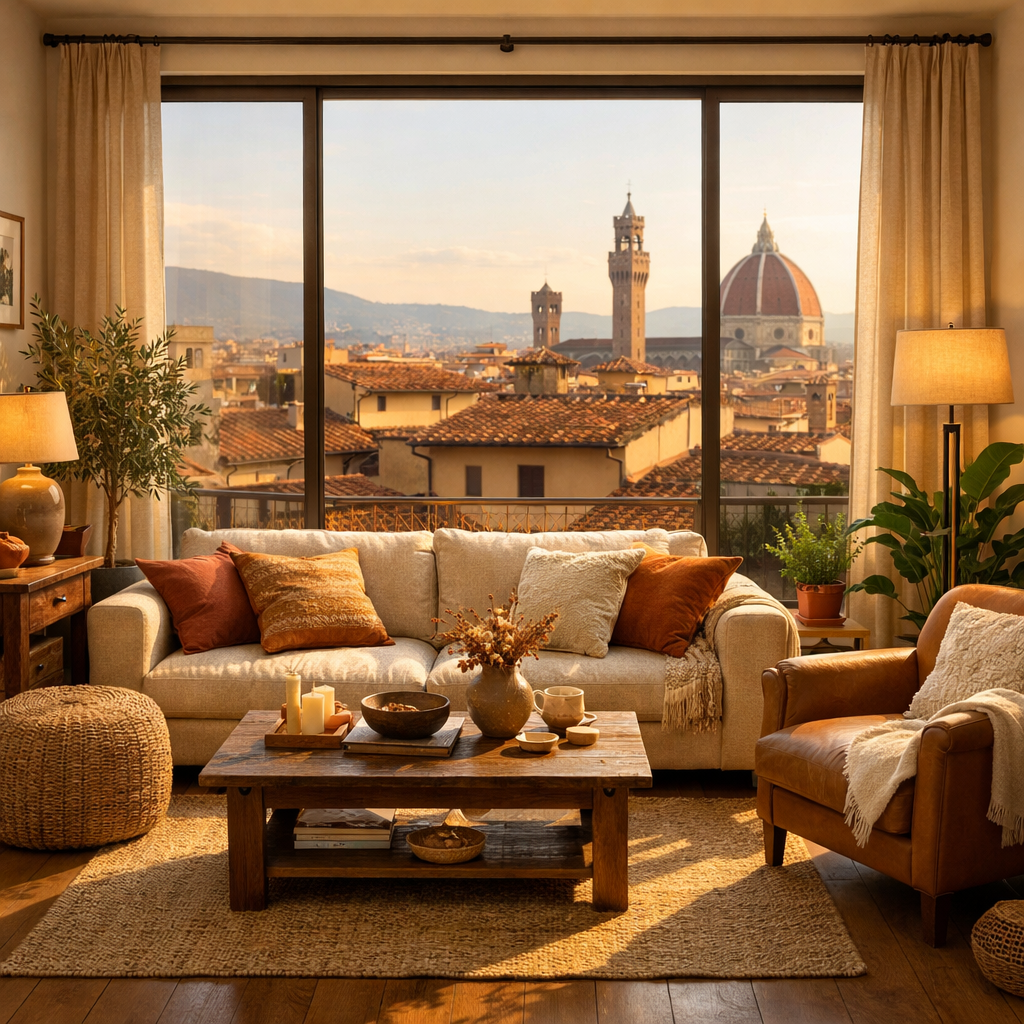
In an apartment like Guido Monaco, you get distinct living zones: a bedroom for sleeping, a living area for relaxing, a kitchen for cooking, and — critically — a private terrace for doing nothing. That last part is important. Florence is intense. The crowds, the heat (in summer), the sensory overload of so much beauty — you need somewhere to decompress. A hotel room doesn't cut it. A private terrace with a glass of Chianti does.
The Terrace Effect
One of the most common things guests mention about staying in a Florence apartment with outdoor space is how it changes their trip rhythm. Instead of rushing from attraction to attraction, they naturally build in downtime: morning coffee on the terrace, an afternoon rest, evening aperitivo watching the sunset. The trip becomes less exhausting and more enjoyable.
Privacy and Independence
Hotels are social spaces. Lobbies, elevators, breakfast rooms, hallways — you're constantly around other people. For some travelers that's fine. For others, especially couples or introverts, it's draining.
An apartment gives you a front door and a key. Behind that door, you're in your own space. No housekeeping knocking at inconvenient times, no neighboring room noise at midnight, no breakfast rush at 8am.
You set your own schedule completely:
- Wake up when you want
- Eat when you want
- Come and go without passing through a lobby
- Do laundry on your own terms (most apartments have washing machines — extremely useful for trips longer than 4 days)
- Store groceries, leftovers, wine — whatever you want
This independence is particularly valuable for:
- Couples who want romantic privacy
- Families with children who need flexible schedules
- Remote workers who need quiet focus time
- Longer stays (5+ nights) where hotel routine becomes tedious
The "Live Like a Local" Factor
This phrase is overused in travel marketing, but in Florence it actually means something specific.
When you stay in a hotel in the centro storico, your daily routine looks like this: leave hotel → navigate tourist crowds → eat at tourist restaurants → return to hotel. You see Florence, but you don't feel it.
When you stay in a residential neighborhood near the station, your routine shifts:
- Morning: Buy a cornetto from the bakery where the barista knows the regulars. Grab espresso standing at the bar, Italian style. Cost: €2.
- Midday: Pick up fresh mozzarella, tomatoes, and bread from the neighborhood alimentari. Make lunch on your terrace.
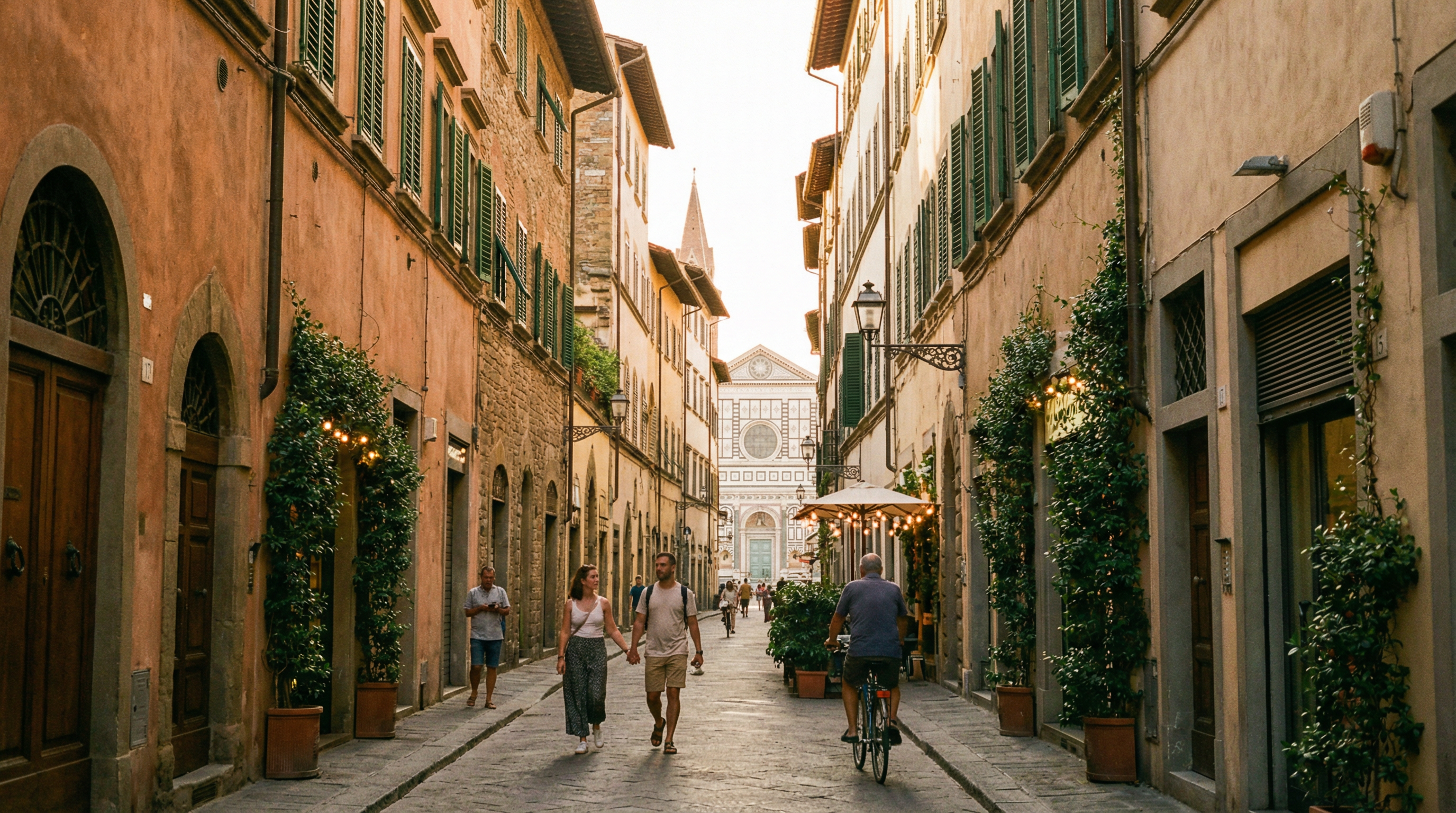
- Afternoon: Walk to the museums through streets where locals actually live — past schools, pharmacies, dry cleaners, real life.
- Evening: Eat at a trattoria where the menu is only in Italian and the owner recommends the daily special.
The difference is subtle but real. You feel less like a visitor consuming Florence and more like a person temporarily living there. That feeling is worth something.
When Hotels Actually Win
To be fair, there are situations where a Florence hotel makes more sense:
- One-night stays: If you're just passing through, a hotel's simplicity wins. No key handoff logistics, no figuring out the kitchen.
- Luxury experience: If you want a concierge, room service, a pool, and daily housekeeping, a 4-5 star hotel delivers that. Apartments don't.
- Accessibility needs: Hotels are more likely to meet specific accessibility requirements. Check apartment listings carefully if this matters.
- Group travel without cooking interest: If nobody in your group wants to use a kitchen, the apartment's main financial advantage disappears.
For everyone else — couples, families, solo travelers staying 3+ nights, remote workers, budget-conscious visitors — an apartment is the stronger choice.
What to Look for in a Florence Apartment
Not all apartments are equal. Here's what separates a good Florence rental from a disappointing one:
Must-Haves
- Air conditioning — Florence summers are brutal (35°C+). Non-negotiable.
- WiFi — Check reviews for actual speed. "WiFi available" can mean 5 Mbps, which is unusable for video calls.
- Elevator — Florence buildings are old. Hauling luggage up four flights of narrow stairs is not romantic.
- Washing machine — Essential for stays over 4 nights. Pack lighter, stay fresher.
- Fully equipped kitchen — Not just a microwave and kettle. Look for a proper stove, moka pot or Nespresso, pots and pans.
Nice-to-Haves
- Private terrace or balcony — Transforms the experience, especially for morning coffee and evening wine.
- Dishwasher — Rare in Florence rentals, but a real quality-of-life improvement.
- Smart TV — For those rest days when you need a break from sightseeing.
- Proximity to the train station — Makes day trips effortless and arrival/departure smooth.
Red Flags
- No reviews or very few reviews
- Photos that look too good to be true (stock images)
- Unclear check-in process
- No mention of AC (assume it doesn't have it)
- Ground floor in a busy street (noise issues)
The Guido Monaco Example
Full transparency: we're biased here, but the Guido Monaco apartment on Via Guido Monaco checks every box above.
- 55m² with separate bedroom and living area
- Private terrace
- Elevator (second floor)
- Air conditioning throughout
- High-speed WiFi
- Fully equipped kitchen with dishwasher
- Washing machine
- 5 minutes from Santa Maria Novella station
- 12 minutes to the Duomo on foot
- 9.0/10 rating on Booking.com from 21 verified reviews
It costs roughly half of what a comparable hotel would charge, with twice the space and all the advantages described above.
How to Book the Right Florence Apartment
- Book early for peak season (April-October). The best apartments sell out months ahead.
- Read the reviews carefully. Pay attention to comments about noise, cleanliness, and check-in.
- Use reputable platforms. Booking.com offers verified reviews and buyer protection.
- Confirm the exact address before booking. "Central Florence" can mean very different things.
- Ask about check-in logistics. Self-check-in with a lockbox is the most flexible option.
Ready to Try the Apartment Experience?
If you're planning a Florence trip and leaning toward an apartment, the Guido Monaco apartment is a strong starting point. It's the kind of place that converts hotel travelers into apartment travelers permanently.
Check availability and rates on Booking.com
Related Reading:
Book Your Florence Stay
Experience the comfort of Guido Monaco apartment — perfect location, modern amenities, and a private terrace.