Florence Museums Guide: How to Visit the Uffizi, Accademia, and More Without the Wait
Florence has a problem most cities would envy. Its museums are so extraordinary — and so famous — that visiting them without planning can cost you half a day standing in a queue that winds around ancient stone buildings in the summer heat.
The good news: it doesn't have to be that way. With a few weeks of foresight (or a few smart tricks), you can walk through the doors of the Uffizi Gallery, stand in front of Michelangelo's David, and tour Florence's other world-class collections without the wait eating into your trip.
This guide covers everything you need to know — which museums to prioritise, exactly how to book tickets, the best time windows, and a few insider notes that most travel sites skip.
Quick Overview: Florence's Top Museums at a Glance
| Museum | Highlights | Queue Risk | Advance Booking |
|---|---|---|---|
| Uffizi Gallery | Botticelli, Leonardo, Raphael | 🔴 Very High | Essential (book 2–4 weeks ahead in season) |
| Accademia Gallery | Michelangelo's David | 🔴 Very High | Essential |
| Bargello | Donatello, Verrocchio bronzes | 🟡 Moderate | Recommended in high season |
| Palazzo Vecchio | Cosimo I frescoes, rooftop | 🟢 Low | Optional |
| Palazzo Pitti | Royal apartments, Palatine Gallery | 🟡 Moderate | Recommended |
| Museo dell'Opera del Duomo | Original Ghiberti Doors, Michelangelo's Pietà | 🟡 Moderate | Recommended |
| Museo Nazionale del Bargello | Renaissance sculpture | 🟢 Low | Optional |
The Uffizi Gallery: What You Need to Know
The Uffizi is arguably the world's greatest collection of Renaissance paintings. Housed in a building commissioned by Cosimo I de' Medici and designed by Giorgio Vasari in the 1560s, it contains over 3,000 paintings across 90 rooms — though you'll focus on perhaps 20–30 key rooms in a typical visit.
What to See
The must-see works are concentrated in the early sections of the gallery:
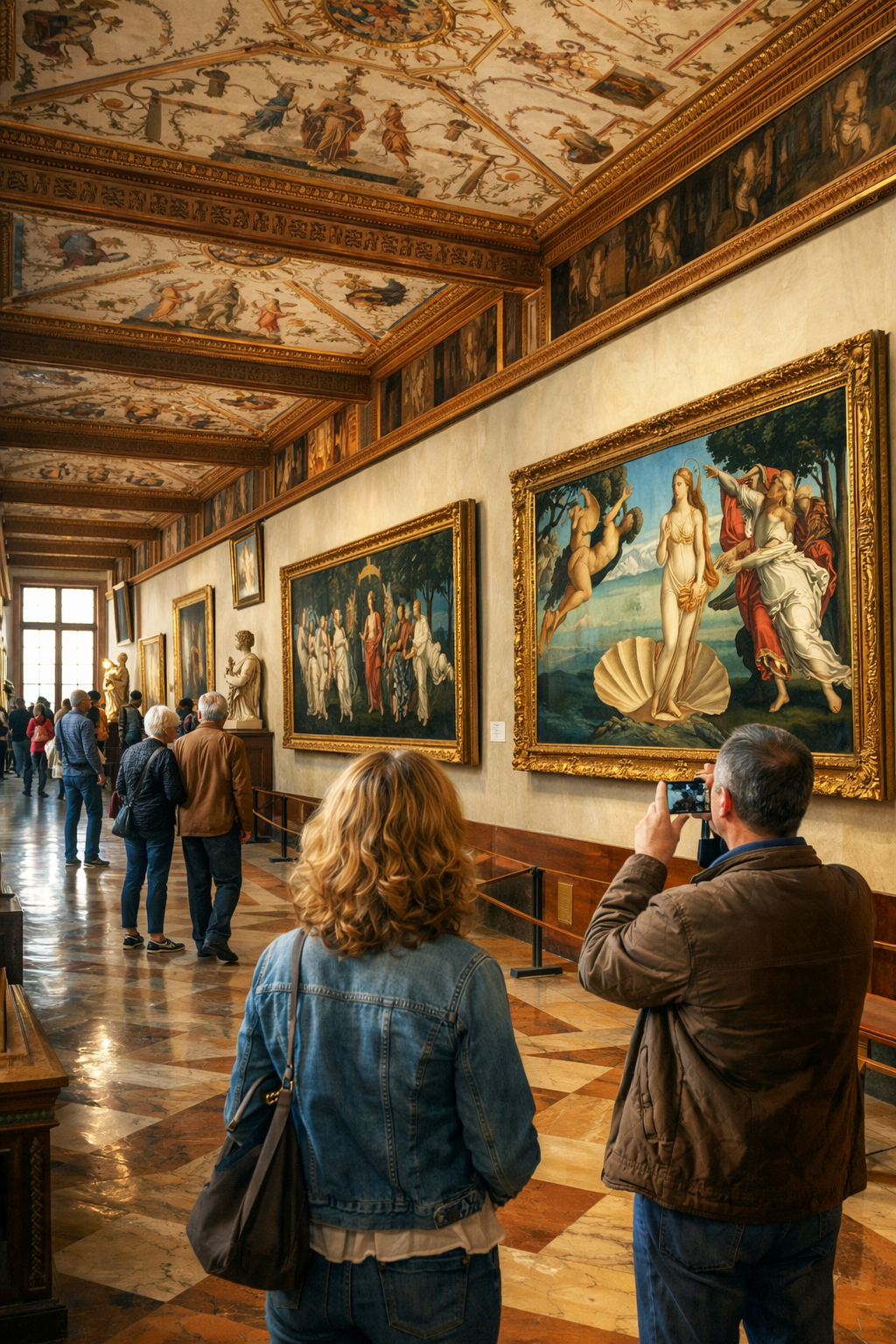
- Botticelli Rooms (10–14): The Birth of Venus and Primavera are here. These two rooms alone justify the entire visit. Come expecting crowds — they are consistently the busiest rooms in the museum.
- Leonardo Room (15): The Annunciation and an unfinished Adoration of the Magi. Extraordinary for understanding Leonardo's early development before he moved to Milan.
- Raphael and Michelangelo Room (41): The Holy Family (Doni Tondo) by Michelangelo shows his sculptural approach to painting. Raphael's Madonna of the Goldfinch hangs nearby.
- Caravaggio Rooms: Two masterpieces — Medusa and the Sacrifice of Isaac — from a painter who changed everything after the Renaissance.
- The Tribune (Room 18): The octagonal room that housed the Medici's most prized pieces. The Venus de' Medici is the centrepiece.
Practical Booking Tips
The Uffizi sells timed-entry tickets through its official platform (uffizi.it). In high season (April through October), same-day or next-day tickets are essentially impossible to find online.
Book 2–4 weeks in advance for visits between April and October. In November through February, 3–7 days ahead is usually sufficient, and occasionally same-week slots appear.
The booking fee is a few euros on top of the standard admission price — worth every cent to skip a queue that can reach 2–3 hours on busy summer days.
Best time slots: First entry (when the museum opens) or a late afternoon slot 90 minutes before closing. The post-lunch crowd is at its thickest between 11am and 2pm.
Avoid Tuesdays: The Uffizi is closed on Mondays, so Tuesday draws the accumulated demand. Wednesday through Friday typically have the lightest crowds of the working week.
How Long to Allow
For a first visit, budget 2.5 to 3.5 hours. More if you want to study individual works closely. The museum is large and the walk through all the rooms is physically substantial — wear comfortable shoes.
The Accademia Gallery: Michelangelo's David
The Accademia is a one-room destination for most visitors, and that room contains one of the most famous sculptures in the world. David needs no introduction.
What to See
Michelangelo carved David from 1501 to 1504, from a single flawed block of Carrara marble that had been abandoned by two previous sculptors. Standing at 5.17 metres, it is larger than most people expect. The room is calibrated specifically for this work — a domed tribune designed in the 19th century.
Beyond David, the Accademia contains:
- The Prisoners (Prigioni): Four unfinished Michelangelo sculptures that feel almost more powerful than the finished works — human forms emerging from raw stone. They were intended for the tomb of Pope Julius II.
- Gipsoteca Bartolini: A room of 19th-century plaster sculptures by Lorenzo Bartolini, often overlooked but genuinely worth ten minutes.
- Sala del Colosso: A large 19th-century plaster model for a sculpture of the Rape of the Sabine Women by Giambologna.
Practical Booking Tips
The same logic applies as the Uffizi: book ahead, especially in season. The Accademia's official ticket site (galleriaaccademia.it) is the most reliable source.
Combination visits: It is physically possible to visit both the Uffizi and the Accademia on the same day — they are roughly 15–20 minutes apart on foot. However, this is a heavy cultural day. Most visitors find one major museum per day more enjoyable. If you do both in one day, visit the Accademia first (it typically takes 1.5–2 hours) and spend the afternoon at the Uffizi.
Photography: You can photograph David without flash — take your time, the room allows some space to observe from different angles. The museum does get crowded around the sculpture itself, so if you want a quieter moment, arrive at opening time.
The Bargello: Florence's Underrated Masterpiece
If you had to pick one museum in Florence that consistently rewards visitors with fewer crowds and equally magnificent art, it would be the Bargello.
This 13th-century building — formerly the city's main prison — houses what is effectively the world's finest collection of Renaissance sculpture outside of the Vatican. The names attached to the works here are the same names you find in the Uffizi: Donatello, Michelangelo, Verrocchio, Cellini, Ghiberti.
What to See
- Donatello's David: The first freestanding nude male figure cast in bronze since antiquity. Remarkably sensual and strange. This piece predates Michelangelo's David by some 50 years and represents a completely different artistic sensibility.
- Verrocchio's David: Cast in bronze around 1475, this is a youthful, confident David often cited as a possible model for the young Leonardo da Vinci. The two Davids in the same room is one of those rare moments in art history made tangible.
- Benvenuto Cellini's Bust of Cosimo I: Brutal, technically astonishing, and historically charged.
- Ghiberti's and Brunelleschi's Competition Panels: The two famous trial reliefs submitted for the Baptistery doors competition of 1401 — a moment that effectively launched the Renaissance.
The Bargello is typically far less crowded than the Uffizi or Accademia. Budget 1.5 to 2 hours.
Palazzo Pitti and the Boboli Gardens
The Pitti Palace, commissioned by banker Luca Pitti in 1458 and later purchased by the Medici, sits just south of the Arno on the Oltrarno side. It is enormous — the largest palazzo in Florence — and contains several separate museums under one roof.
What's Inside
- Palatine Gallery: The Medici's private art collection, displayed in richly decorated rooms. Major works by Raphael, Titian, Rubens, and Caravaggio. Less curated than the Uffizi, more like walking into an aristocratic home where art is everywhere.
- Royal Apartments: The lavishly furnished rooms used by the House of Savoy during Florence's brief period as Italy's capital (1865–1871).
- Modern Art Gallery: 19th-century Italian painting — underrated, genuinely interesting if you want to understand the Macchiaioli movement.
- Boboli Gardens: The formal garden behind the palace, laid out in 1550. Spectacular views over Florence and a genuinely peaceful space.
A combined ticket (museums + gardens) is available. Allow at least half a day if you want to do justice to both the interiors and the gardens.
Museo dell'Opera del Duomo: The Duomo's Hidden Treasure House
This museum beside the Cathedral is one of the most undervisited major collections in Florence — and arguably the single most rewarding museum you can visit in an hour.
It houses the original sculptural and decorative works that have been removed from the Duomo complex over the centuries for conservation, replaced by copies in situ.
Not to Miss
- Ghiberti's Gates of Paradise: The original panels from the East Baptistery doors — the ones Michelangelo reportedly called the "Gates of Paradise." Standing in front of the originals, up close, is an entirely different experience from the replicas outside.
- Michelangelo's Bandini Pietà: A late, unfinished work showing the Madonna, Mary Magdalene, and Nicodemus supporting Christ. Michelangelo reportedly smashed this sculpture in frustration — the repaired cracks are still visible. The hooded figure of Nicodemus is traditionally said to be a self-portrait.
- Donatello's Magdalene: A haunting late wooden sculpture, haggard and ascetic, unlike anything else in Florence.
- Luca della Robbia's Cantoria: A marble singing gallery of extraordinary delicacy, carved in the 1430s.
The Opera del Duomo is included in the combined Duomo complex ticket — good value if you're visiting the Cathedral, Baptistery, and Campanile in the same day.
Practical Tips for Museum Planning in Florence
Free Museum Days
The Italian government designates the first Sunday of each month as a free entry day for all state museums, including the Uffizi and Accademia. This sounds attractive but comes with a significant caveat: everyone knows about it. These days are extremely crowded, especially in tourist season. If you plan to go on the first Sunday, arrive before the museum opens.
Museum Passes and Combination Tickets
- Uffizi + Pitti + Boboli: A combined ticket covers all three state museum sites. Useful if you're planning to visit all of them within a few days.
- OPA (Opera del Duomo) Pass: Covers the Cathedral complex including the Baptistery, Museo dell'Opera del Duomo, Giotto's Campanile, and the Dome climb. Valid for 72 hours and excellent value.
What to Carry
Bring water (museums can be warm in summer), minimal bags (security checks at major museums require bags smaller than a certain size; large backpacks may need to be checked), and comfortable shoes. Many museums have strict no-food policies inside the gallery spaces.
Official Booking Platforms
Always book directly through official museum sites. Third-party "skip the line" services are often simply reselling official tickets at a markup — the ticket is the same, the price is higher.
Staying Close to Florence's Museums: Why Location Matters
Florence is compact, but the concentration of major museums in the historic centre means your accommodation's location makes a real difference to how you plan your days.
The Guido Monaco Apartment is located steps from Santa Maria Novella station — which puts you within easy walking distance of nearly every major museum in the city. The Uffizi is roughly a 20-minute walk along the Arno. The Accademia and Bargello are about the same distance in different directions. The Duomo complex is a 12-minute walk through the city centre. The Palazzo Pitti is 25 minutes on foot via the Ponte Vecchio — a walk worth doing even without a museum at the end of it.
Starting your mornings from the apartment, you can be at the museum doors for opening time without needing a taxi or bus. The 9.0/10 guest rating reflects exactly this kind of practical convenience — a base that works for the full range of experiences Florence offers, not just a room to sleep in.
If you're planning a museum-focused Florence trip and want to lock in accommodation near the train station with easy access to the historic centre, you can check availability directly: Book the Guido Monaco Apartment on Booking.com
FAQ: Florence Museums
Do I really need to book the Uffizi in advance? In high season (April through October), yes — absolutely. Tickets can sell out weeks ahead. In low season (November through March), you have more flexibility, but advance booking is still recommended for weekends and holidays.
Can I visit the Uffizi and Accademia on the same day? Yes, but it's a full day. Both are substantial visits. Book the Accademia for the morning (it's typically 1.5 hours) and the Uffizi for the afternoon. Factor in lunch and walking time — the two museums are about 20 minutes apart on foot.
What's the best museum in Florence for someone with only two hours? The Accademia, if you're a first-time visitor who wants to see David. The Bargello, if you want extraordinary Renaissance sculpture with almost no queue. The Museo dell'Opera del Duomo, if you want to maximise quality per square metre of floor space.
Are there free museums in Florence? Yes. All state museums are free on the first Sunday of each month. The Palazzo Vecchio courtyard is free to enter (only the interior requires a ticket). Several smaller churches and oratories have significant artworks that can be viewed for free or a small donation — the Orsanmichele church, for example, contains original Donatello bronzes in its niches.
Is the Bargello really worth visiting if I've already done the Uffizi? Yes — completely different type of art (sculpture versus painting), significantly fewer crowds, and several works that are individually as important as anything in the Uffizi. Donatello's two Davids alone make it worthwhile.
What should I do if I arrive in Florence without museum tickets booked? Go early. Museum queues are longest from 10am to 2pm. Arriving 30–45 minutes before opening for a standard-queue ticket in shoulder season (March, October, November) is often manageable. In July and August, even this strategy may not work — online booking is genuinely the only reliable approach.
Are museums in Florence stroller/wheelchair accessible? The major museums (Uffizi, Accademia, Pitti) have elevator access for prams and wheelchairs, though the historic buildings mean some areas have uneven surfaces. Call ahead or check the museum's accessibility page if this is a priority.
Book Your Florence Stay
Experience the comfort of Guido Monaco apartment — perfect location, modern amenities, and a private terrace.