Florence Duomo Complete Visitor Guide (2026): Tickets, Dome Climb & Insider Tips
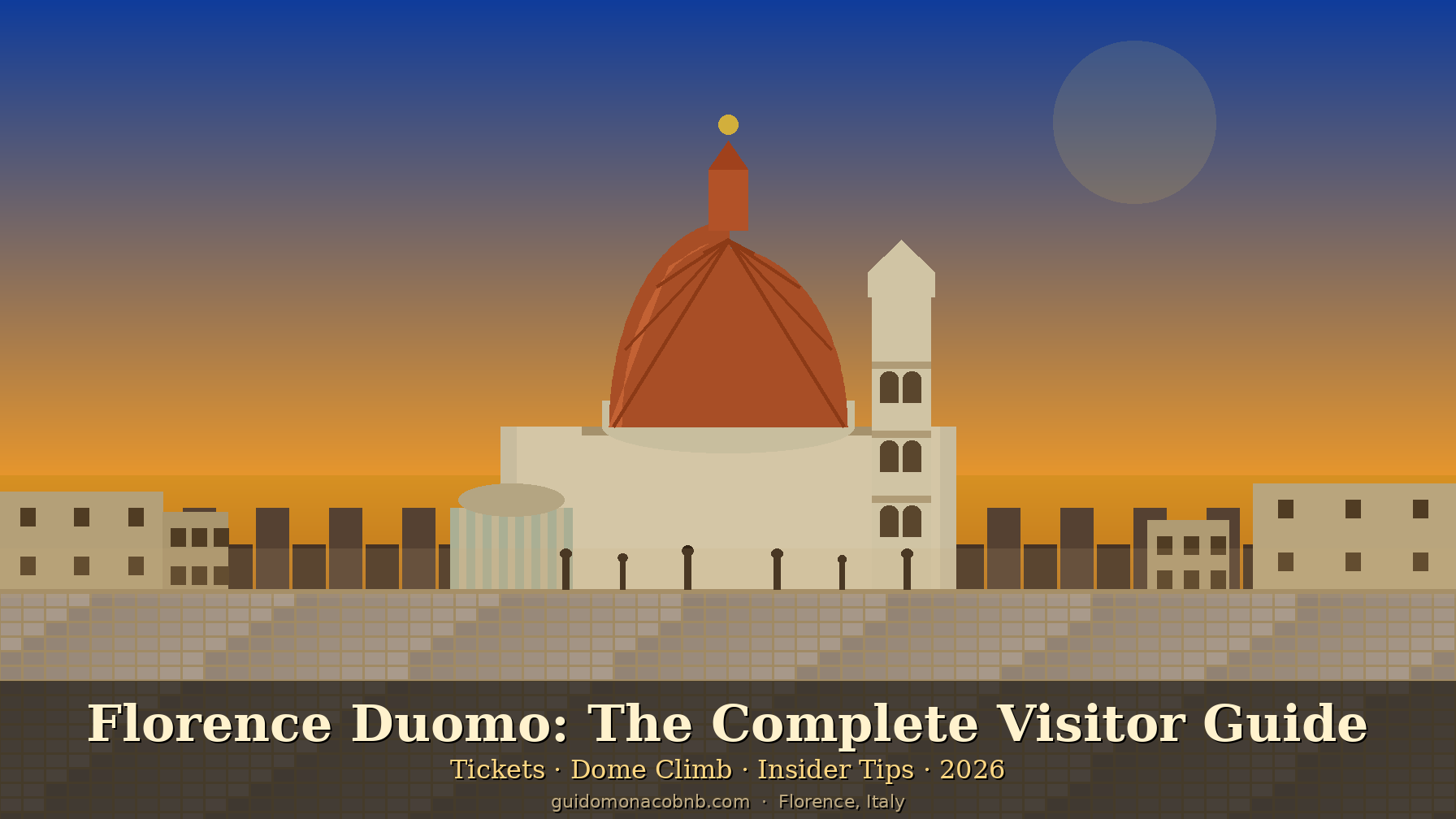
Few sights in the world stop you in your tracks quite like Florence's Cathedral of Santa Maria del Fiore — the Duomo. Rising above the city's red-tiled rooftops, Filippo Brunelleschi's soaring terracotta dome has defined the Florentine skyline for nearly six centuries. Whether you're lining up to climb those 463 steps, marvelling at the gold mosaics inside the Baptistery, or simply standing in the piazza open-mouthed at dusk, the Duomo complex is the beating heart of Florence.
This guide covers everything you need to know in 2026: tickets, opening hours, what to see in each monument, how to avoid queues, and the best insider tips for making the most of every minute.
The Duomo Complex: Five Monuments, One Ticket
Many visitors don't realise that "the Duomo" is actually a complex of five interconnected monuments, all managed under the Opera di Santa Maria del Fiore. A single combined ticket — the Brunelleschi Pass — grants access to all of them.
| Monument | What you'll see | Approximate visit time |
|---|---|---|
| Cathedral (Santa Maria del Fiore) | Gothic interior, Vasari's frescoed dome, Uccello's clock | 30–45 min |
| Brunelleschi's Dome | 463-step climb, spectacular 360° panorama | 45–60 min |
| Giotto's Campanile | 414-step bell tower, close-up dome views | 30–45 min |
| Baptistery of San Giovanni | Ghiberti's Gates of Paradise, Byzantine mosaics | 30–45 min |
| Duomo Museum (Museo dell'Opera) | Original Ghiberti doors, Michelangelo's Pietà | 60–90 min |
Brunelleschi Pass (2026 price): €30 per adult, valid for 72 hours. Children under 6 enter free. The pass is non-refundable and date-timed entry is required for the Dome and Campanile. Crucially, the Cathedral interior itself is free — you only need the pass for the Dome, Campanile, Baptistery, crypt, and museum.
Insider tip: The Duomo Museum is dramatically undervisited and holds some of the greatest treasures of the complex — including the original, breathtaking Gates of Paradise that were replaced on the Baptistery by high-quality replicas. Spend proper time here.
Brunelleschi's Dome: The Crown Jewel
Why It's So Remarkable
When Filippo Brunelleschi completed the dome in 1436, it was the largest brick dome ever built — and remains so today. With no flying buttresses, no external scaffolding, and using a double-shell herringbone brick technique that he essentially invented, Brunelleschi solved a structural puzzle that had stumped architects for generations. The dome weighs approximately 37,000 tonnes and spans 45.5 metres across its internal diameter.
The Climb
The entrance to the dome climb is on the north side of the Cathedral, on Via della Canonica. You'll need a timed-entry ticket booked in advance (included with the Brunelleschi Pass).
The ascent involves 463 steps, no lift, and narrow passages between the inner and outer shells. Along the way, you pass through:
- The terrace at the base of the dome — your first elevated view over Florence
- The drum level — where you walk between the shells and see the construction from the inside
- Vasari's frescoes up close — the enormous Last Judgement fresco by Giorgio Vasari and Federico Zuccari covers 3,600 square metres; from certain points in the climb you're just metres from the painted surface
- The lantern at the top — a 360° panorama over the city, the Arno valley, and the Tuscan hills
Allow at least 1 hour for the full climb and descent. Wear comfortable, non-slip shoes. The stairwells are narrow — if you have claustrophobia, this may not be for you. The views at the top are, however, utterly spectacular and worth every step.
When to Climb
The dome opens from 8:15 AM, and morning slots fill fastest. If you want to avoid crowds at the summit:
- First entry of the day (8:15–9:00 AM) — fewest people, soft morning light over the city
- Last entry of the day (around 6:00 PM) — the dome closes at 7:00 PM; golden hour from the top is magical but slots run out fast
Avoid midday entries (11 AM–2 PM) — this is peak queue time and the stairwell becomes congested.
The Cathedral Interior: Free to Enter
The interior of Santa Maria del Fiore is free to enter and requires no ticket. It is, however, accessed through a separate door (the main entrance on the west façade) and you cannot go directly from the Cathedral interior into the Dome climb.
What to Look For Inside
Vasari's dome fresco: Even from the Cathedral floor, looking up at the Last Judgement is awe-inspiring. The damned writhe in Hell at the base of the dome; heaven radiates upward in golden rings.
Paolo Uccello's clock: Near the main entrance, above the doorway, is one of Florence's most unusual treasures — a liturgical clock painted by Uccello in 1443. It runs backwards (anti-clockwise) and was designed to count the 24 hours from the point of sunset.
Equestrian portraits: Two large fresco portraits of condottieri (mercenary commanders) — John Hawkwood (1436) by Paolo Uccello and Niccolò da Tolentino (1456) by Andrea del Castagno — flank the nave. These remarkable works simulate marble sculpture; they are among the first equestrian portraits in Western art.
Dante's Divine Comedy fresco: Domenico di Michelino's celebrated painting (1465) shows Dante holding the Divine Comedy against a backdrop of Florence's skyline, Heaven, Purgatory, and Hell.
Opening hours: The Cathedral interior opens Monday–Saturday from 10:30 AM and Sunday from 1:30 PM. It closes at 5:00 PM daily (last entry 4:30 PM). Note that the Cathedral closes on religious feast days for services.
Giotto's Campanile: The Best Views of the Dome
If climbing the Dome feels daunting, Giotto's Campanile offers an outstanding alternative — and from its summit you get the best view of Brunelleschi's Dome, because you're looking directly at it rather than standing on top of it.
The tower is 84.7 metres tall, reached via 414 steps. The lower sections house copies of the decorative marble reliefs that originally adorned the tower; the originals are preserved in the Duomo Museum.
Pro tip: Many photographers prefer the Campanile for golden-hour shooting precisely because you can photograph the Dome against the Tuscan landscape, which you can't do from the Dome itself.
Opening hours mirror the Dome: from 8:15 AM, last entry around 6:30 PM. Included with the Brunelleschi Pass.
The Baptistery of San Giovanni
The Baptistery is one of Florence's oldest buildings, dating to at least the 11th century — though Florentines in Dante's era believed it to be an ancient Roman temple. It stands directly west of the Cathedral, separated from it by a narrow piazza.
Ghiberti's Gates of Paradise
The eastern doors of the Baptistery — Lorenzo Ghiberti's Gates of Paradise — are widely considered among the greatest works of Renaissance art. Completed in 1452 after 27 years of work, the gilded bronze panels depict ten scenes from the Old Testament with an extraordinary sense of pictorial depth and narrative drama. Michelangelo reportedly called them "worthy to be the gates of Paradise," and the name stuck.
The doors you see today are high-quality replicas installed to protect the originals from pollution. The originals are displayed in pristine condition at the Duomo Museum.
The Interior Mosaics
Inside the Baptistery, the ceiling is covered in glittering Byzantine-style mosaics begun in the 13th century. The central panel depicts Christ in Majesty; surrounding panels illustrate the Last Judgement, the life of John the Baptist, and scenes from Genesis. The sheer scale and jewel-like quality of these mosaics make the Baptistery one of Florence's most beautiful interiors — and one that many visitors underrate.
Opening hours: Monday–Saturday 8:15 AM–10:15 AM and 11:15 AM–7:30 PM; Sunday 8:15 AM–1:30 PM.
The Duomo Museum (Museo dell'Opera del Duomo)
Opened in its current expanded form in 2015, the Duomo Museum is housed directly behind the Cathedral and is — many argue — the finest museum in Florence outside the Uffizi. It's also the complex's most uncrowded gem.
Highlights
The Gates of Paradise: Both panels of Ghiberti's original eastern doors are displayed here in a climate-controlled gallery at eye level. The detail is astonishing — pilgrims, prophets, atmospheric perspective, and gilded landscapes. See them here rather than in the sunlight outside, where the replicas lose some subtlety.
Michelangelo's Bandini Pietà: This late, tortured Pietà — Michelangelo carved it in his seventies and reportedly intended it for his own tomb — shows Nicodemus cradling the dead Christ. Art historians believe Nicodemus is a self-portrait. Michelangelo later smashed the sculpture in frustration; a pupil reassembled it. The damage is still visible.
Donatello's Mary Magdalene: A haunting, almost savage wooden sculpture of a penitent Mary Magdalene, emaciated and wild-haired. It's unlike anything else Donatello made.
The original marble panels from the Campanile: Luca della Robbia's famous relief carvings of musicians, dancers, and scholars — the Cantoria (singers' gallery) — are displayed alongside the Campanile's narrative reliefs by Andrea Pisano and others.
Opening hours: Monday–Sunday, 9:00 AM–7:00 PM (last entry 6:00 PM). Closed on the first Tuesday of each month.
Tickets: How and When to Book
Book Online in Advance — It's Non-Negotiable
The Brunelleschi Pass sells out weeks ahead in peak season (April–October). Attempting to buy tickets on the day, especially for the Dome, is usually futile in spring and summer.
Official booking website: operaduomo.firenze.it
Key booking rules:
- The Dome and Campanile require a specific timed-entry slot
- Other monuments (Cathedral, Baptistery, Museum) can be visited at any time within the 72-hour validity period
- Tickets are non-refundable
- Bring your ticket on your phone or printed; ID may be checked
Ticket Price Summary (2026)
| Ticket | Price |
|---|---|
| Brunelleschi Pass (all 5 monuments) | €30 |
| Cathedral only | Free |
| Dome only (if sold separately) | Not available; pass required |
| Children under 6 | Free for all monuments |
| EU residents 18–25 | Check operaduomo.firenze.it for discounts |
Getting There from Near Santa Maria Novella
The Duomo is a 15-minute walk from Santa Maria Novella station along some of Florence's most elegant streets. From Via Guido Monaco, head east via Via dei Fossi and Via dei Tornabuoni (with its flagship designer boutiques), then turn right at Via degli Strozzi, bearing left onto Via dei Calzaiuoli — the pedestrianised street that leads directly to the Cathedral piazza.
Staying near Santa Maria Novella puts you closer to the Duomo than most hotels in the city — and the walk itself is a pleasure, passing Piazza della Repubblica and the Mercato Nuovo.
By foot: 15 minutes By taxi: 5 minutes (rarely worth it given traffic in the historic centre) By bus: Not recommended for this short distance; the historic centre is pedestrianised
Duomo Visit Planning: A Suggested Order
To make the most of your 72-hour pass and avoid the worst of the crowds, here's a suggested order:
- Early morning (8:15 AM) — Dome climb (book first entry slot; quietest time)
- Mid-morning — Cathedral interior (free; just walk in after descending the dome)
- Late morning — Baptistery (morning slots tend to be less crowded)
- Lunch break — Explore the streets south towards Piazza della Signoria
- Afternoon — Duomo Museum (undervisited; afternoon is perfect)
- Late afternoon / evening — Campanile (for golden-hour dome views and photos)
This order front-loads the Dome — which must be timed — and leaves the more flexible monuments for later in the day.
Practical Tips & Common Mistakes
Dress code: The Cathedral has a strict dress code. Shoulders and knees must be covered. If you arrive in shorts or sleeveless tops, you may be turned away or asked to purchase a covering. Pack a scarf or light jacket.
Photography: Photography is permitted in all five monuments. Flash photography is prohibited inside the Cathedral. Tripods are not permitted.
The Dome vs. the Campanile: If you can only do one climb, the Dome is the more iconic experience. If you want the best photographs of the Dome, do the Campanile.
Queue management: Even with a timed ticket, expect short queues for security screening. Arrive 10–15 minutes before your slot.
Avoid piazza touts: Unofficial "tour guides" operating in the piazza may offer tickets or access — these are invariably fraudulent. Buy only from the official website or the official ticket office on Piazza San Giovanni, 7.
The Crypt of Santa Reparata: Included with the Brunelleschi Pass, the crypt below the Cathedral preserves remains of the earlier church that preceded the Duomo, including what is believed to be Brunelleschi's tomb. It's easy to miss but worth including.
Nearby Highlights to Combine with Your Duomo Visit
The Duomo sits at the geographic and cultural heart of Florence. Within a 10-minute walk you'll find:
Piazza della Signoria and the Palazzo Vecchio: Florence's civic heart, with the open-air Loggia dei Lanzi sculpture gallery (free to view) and the Palazzo Vecchio museum.
The Uffizi Gallery: Perhaps the world's greatest collection of Renaissance painting — Botticelli's Birth of Venus and Primavera, Leonardo, Raphael, Titian. Book well in advance. A 10-minute walk south of the Duomo.
Mercato Centrale: Florence's magnificent iron-and-glass market (1874), a 10-minute walk back towards Santa Maria Novella, with a superb food hall on the upper floor.
Piazza della Repubblica: The elegant piazza on the former site of the Roman forum and later the city's Jewish ghetto, lined with historic cafés including Caffè Gilli, open since 1733.
Frequently Asked Questions
How long does it take to visit the entire Duomo complex?
Allow a full half-day — roughly 4 to 5 hours — to visit all five monuments properly. If you're short on time, prioritise the Dome climb and the Duomo Museum.
Can I visit the Cathedral for free?
Yes. The Cathedral interior (Santa Maria del Fiore) is free and open to the public. You only need a paid ticket (the Brunelleschi Pass) to access the Dome, Campanile, Baptistery, crypt, and museum.
How far in advance should I book Duomo tickets?
In peak season (April through September), book at least 2–3 weeks in advance for the Dome. In October through March, a few days' notice is usually sufficient, but booking ahead is always advisable.
Is the Dome climb suitable for children?
The 463-step climb is doable for most children aged 7 and up. The stairwell is very narrow in sections; younger children may find it frightening. There is no lift. Children under 6 enter for free but the climb itself may not be appropriate.
What is the best time of day to visit the Duomo piazza?
Early morning (before 9:00 AM) and late evening (after 7:00 PM, when the monuments have closed) are the best times to photograph the Cathedral exterior without crowds. The piazza is illuminated at night and makes for exceptional evening photography.
Can I visit the Duomo on a Sunday?
Yes, though opening hours differ. The Cathedral is only open for tourist visits from 1:30 PM on Sundays (mornings are reserved for Mass). The Baptistery closes earlier on Sundays. Check the official website for the most up-to-date Sunday schedules.
Is the Duomo complex accessible for visitors with limited mobility?
The Cathedral interior, Baptistery, and Duomo Museum are accessible to visitors with limited mobility. The Dome climb and Campanile are not accessible — both require climbing several hundred narrow steps with no lift option.
Are audio guides available?
Audio guides are available for rent at the ticket office. Alternatively, the Duomo Museum provides excellent interpretive panels. Several excellent third-party apps (including Rick Steves Audio Europe) offer free audio tours of the complex.
Staying near Via Guido Monaco places you just a 15-minute walk from the Duomo piazza — one of the most convenient locations in Florence for exploring the historic centre on foot. Our guests regularly tell us that rolling out of bed and strolling to the Cathedral at opening time, before the tour groups arrive, is one of the highlights of their stay.
Book Your Florence Stay
Experience the comfort of Guido Monaco apartment — perfect location, modern amenities, and a private terrace.