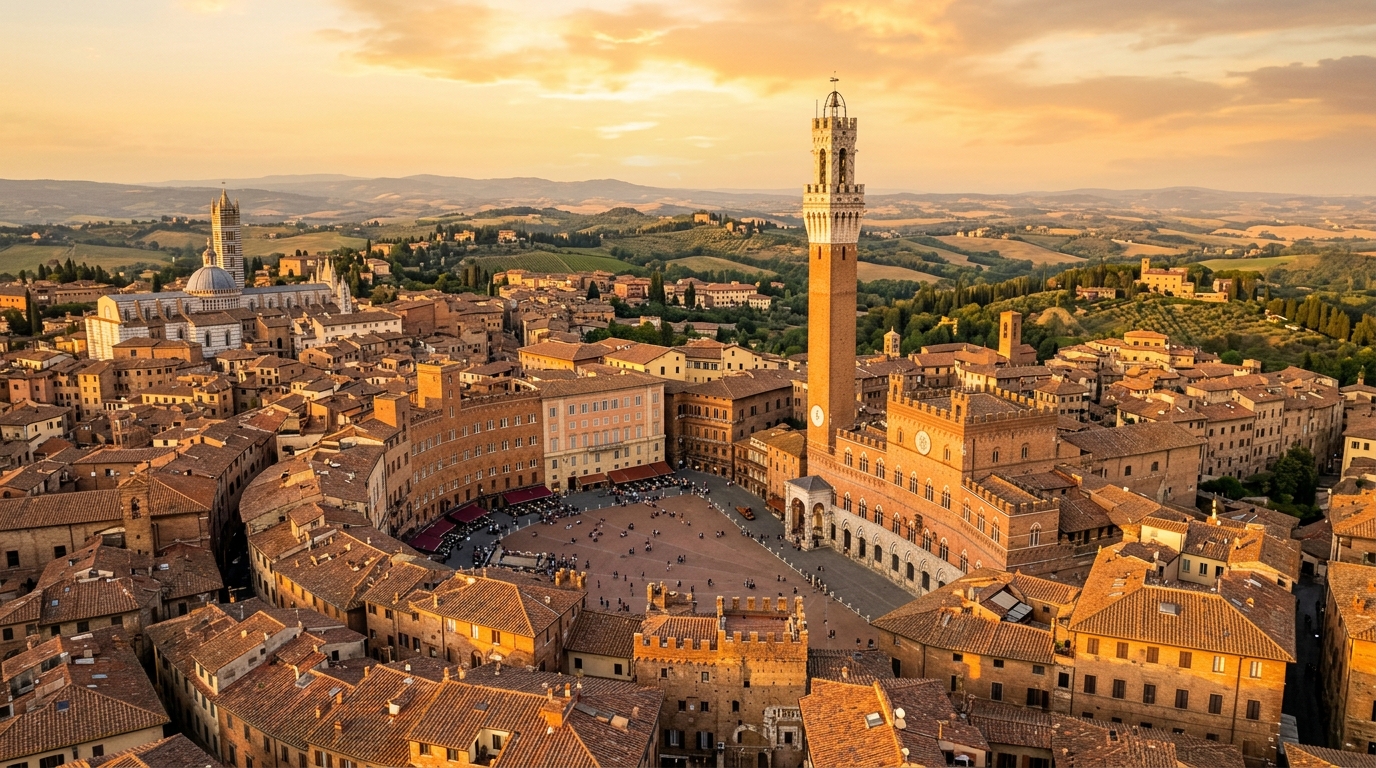
Of all the day trips you can make from Florence, Siena is the one that people talk about for years after. There's something almost theatrical about arriving in this medieval hilltop city: the amber towers, the shell-shaped Piazza del Campo, the golden stone that seems to glow differently depending on the time of day. If you're staying in Florence and wondering whether Siena is worth the journey — the answer is an emphatic yes.
This guide covers everything you need: how to get there, how long to spend, what to see and skip, where to eat, and the practical tips that make the difference between a rushed, confusing day and a genuinely memorable one. We've written it for travellers staying near Santa Maria Novella station, since that's the most common starting point — and the most convenient one.
How to Get from Florence to Siena
Bus: The Fastest and Easiest Option
The single best way to travel between Florence and Siena is by bus, and specifically the Siena Mobilità / Tiemme rapid coach service (formerly known as the Sena or SITA route). Buses depart from Piazza della Stazione (right outside Santa Maria Novella station) and arrive at Siena's Piazza Gramsci — both central, easy locations.
- Journey time: 75–90 minutes via the corsia preferenziale (rapid route along the superstrada)
- Frequency: Roughly every 30 minutes during the day
- Price: Around €8–10 one way (buy tickets at the tabacchi kiosk at the bus station or online at tiemmespa.it)
- Key tip: Buy your return ticket when you buy your outbound — the last afternoon buses can sell out in summer
Avoid the slower "ordinary" bus service (via towns like Poggibonsi) which can take two hours or more. Look for buses labelled "rapida" or "SI – FI Diretto".
Train: Scenic but Slower
You can travel by train, but it requires a change at Empoli or Chiusi-Chianciano Terme, and total journey time is typically 90–120 minutes. For a day trip, the bus is simply better. That said, if you're a train enthusiast or have a rail pass, the Empoli connection is straightforward and the countryside views are lovely.
| Route | Duration | Price | Direct? |
|---|---|---|---|
| Florence → Siena (bus, rapida) | 75–90 min | €8–10 | Yes |
| Florence → Siena (train via Empoli) | 90–120 min | €9–13 | No |
| Florence → Siena (train via Chiusi) | 2h+ | €12–18 | No |
| Private transfer / taxi | 60–75 min | €80–130 | Yes |
Car: An Option, But Parking Is a Challenge
Driving takes about an hour on the A1 motorway. However, Siena's historic centre is a ZTL (Limited Traffic Zone), meaning you cannot drive into the old town at all unless you have a specific permit. Park at one of the city's peripheral car parks — Parcheggio il Campo or Parcheggio San Francesco are the most central — and walk or take the city escalators up into the old town. Budget around €2–3 per hour for parking.
How Long to Spend in Siena
A full day (8–10 hours on the ground) is the ideal amount of time. This gives you a leisurely morning at the Duomo and museums, lunch in the campo or a nearby osteria, an afternoon wandering the contrade (neighbourhoods), and time to sit with a bicchiere di vino as the light softens.
You can technically "see Siena" in half a day, but you'll feel rushed and miss the quieter magic that comes from slipping into a side street when the tour groups have moved on.
Sample Day Structure:
- 8:30 AM — Take the first morning bus from Florence (Santa Maria Novella area)
- 10:00 AM — Arrive at Piazza Gramsci, walk to Piazza del Campo
- 10:30 AM — Torre del Mangia tower climb (before queues build)
- 12:00 PM — Siena Duomo and Museo dell'Opera
- 13:30 PM — Lunch near the campo or in the Terzo di Camollia
- 15:00 PM — Explore the contrade: Fontebranda, Santa Maria dei Servi, Palazzo Pubblico interior
- 17:00 PM — Aperitivo in the campo or at an enoteca
- 18:30 PM — Board the return bus to Florence
- 20:00 PM — Back in Florence for dinner
Top Things to See in Siena
Piazza del Campo
This is Siena's heart, and one of the most extraordinary public spaces in Europe. The fan-shaped square tilts gently toward the Gothic Palazzo Pubblico, and is divided into nine segments representing the nine merchant families who ruled medieval Siena. Twice a year — on July 2nd and August 16th — it becomes the arena for the Palio di Siena, the famous bareback horse race that has been run since the 13th century.
On a normal day, the campo is a place to sit on the warm pavement, watch the world go by, and feel the extraordinary continuity of a city that has looked roughly the same for six hundred years. Get here by 10am before the tour groups arrive; it's a completely different experience.
Torre del Mangia
The 88-metre tower attached to the Palazzo Pubblico is one of the tallest medieval towers in Italy, and the views from the top are worth every one of the 400 steps. You'll see the terracotta roofscape of Siena, the rolling Crete Senesi hills to the south, and — on a very clear day — a faint hint of Monte Amiata on the horizon.
Book tickets in advance if visiting between April and October. The daily admission is capped at around 600 visitors, and it sells out by mid-morning in high season.
Price: €15 adults, €9 children Hours: Daily 10:00–19:00 (March–October), reduced hours in winter
The Siena Duomo (Cathedral of Santa Maria Assunta)
Few cathedrals in Italy are as extravagantly beautiful as Siena's. The façade — striped in black and white marble, covered in Gothic sculpture — is extraordinary before you even step inside. The interior is no less stunning: the floor is an intricate marvel of inlaid marble panels depicting scenes from classical mythology and the Old Testament, many covered for protection but revealed in their entirety for a few weeks each autumn.
Don't miss:
- The Libreria Piccolomini — a room covered floor-to-ceiling in brilliantly coloured Pinturicchio frescoes, accessed from inside the cathedral
- The Baptistery of San Giovanni — the lower church with Donatello's bronze reliefs on the baptismal font
- The Museo dell'Opera — houses the original Duccio di Buoninsegna Maestà, one of the greatest paintings of medieval Europe
OPA SI Pass: Purchase a combined ticket (around €15–20) covering the Duomo, Baptistery, Museo dell'Opera, and access to the rooftop walkway (Facciatone). This is the best value option and can be booked at opasi.it.
The Contrade
Siena is divided into 17 contrade — ancient neighbourhood districts, each with its own symbol (a giraffe, a dragon, a snail, a wolf…), its own church, fountain, and fierce civic pride. Walking through the streets, you'll spot flags and colour-coded drainpipes marking each territory. This isn't just tourist kitsch — the contrade are living institutions. Sienese people identify as members of their contrada first and Sienese second.
If you're curious, seek out the Fonte di Fontebranda (a 13th-century public fountain in the Oca/Goose contrada) or the Museo di Contrada della Chiocciola (Snail contrada museum — one of several small neighbourhood museums that offer a fascinating glimpse into this parallel civic world).
Pinacoteca Nazionale
For those who want to go deeper into Sienese Gothic and early Renaissance painting, the Pinacoteca Nazionale in the 14th-century Palazzo Buonsignori is the place to go. Its collection focuses specifically on the Sienese school — Duccio, Simone Martini, the Lorenzetti brothers — and is largely unvisited compared to the Uffizi, meaning you can spend time with genuinely extraordinary paintings in near-solitude.
Price: €8 adults Hours: Tuesday–Sunday 8:15–19:15
Where to Eat in Siena
Lunch in the Contrade
The best meals in Siena are found in the small trattorie away from the campo — the immediate surroundings of Piazza del Campo are predictably tourist-priced. Walk ten minutes in any direction and prices drop noticeably, while quality often improves.
Look for pici (thick, hand-rolled pasta, the local speciality — served al ragù, cacio e pepe, or with breadcrumbs and anchovies), ribollita (thick Tuscan bean soup), cinghiale (wild boar stew), and the celebrated Bistecca di Chianina if you haven't already tried it in Florence.
Recommended spots:
- Osteria Il Vinaio — traditional, no-frills, local favourite on Via dei Termini. Excellent pici and ribollita at fair prices.
- Trattoria Papei — family-run since the 1960s, on Piazza del Mercato behind the Palazzo Pubblico. Packed with locals at lunchtime.
- Osteria Le Logge — slightly more upmarket, set inside a converted 19th-century pharmacy. Beautiful interior, strong wine list.
- La Vecchia Latteria — good for a quick, cheap lunch: sandwiches, local cheeses, and a glass of Morellino.
Sienese Pastries and Sweets
Siena has one of the richest pastry traditions in Italy:
- Panforte — the ancient spiced fruit and nut cake, sold in every pasticceria and excellent as a gift. Try the Panforte Margherita (lighter, dusted with icing sugar) or the darker Panforte nero.
- Ricciarelli — soft almond biscuits dusted with icing sugar. The real ones are made only in Siena and have IGP protected status.
- Cavallucci — spiced anise cookies, another Sienese classic.
The best pastry shops are Pasticceria Bini (Via dei Fusari) and Pasticceria Nannini on Banchi di Sopra — the latter has been operating since 1840 and is an institution.
Wine
You're in Chianti country (the southern edge), and Siena sits between two of Italy's greatest wine zones: Brunello di Montalcino to the south and Chianti Classico to the north. Any enoteca or osteria worth its salt will pour a good glass. For a proper tasting:
- Enoteca Italiana — a unique national wine library housed in the Medici Fortress, with an extraordinary range of Italian wines available by the glass.
- Il Calice — small, excellent wine bar near the campo with knowledgeable staff and well-priced pours.
Practical Tips for Your Siena Day Trip
Wear Comfortable Shoes
Siena is built on three hills. Even getting from the bus station to the campo involves a significant uphill walk (or you can take the escalators from Piazza Gramsci). The streets are all cobblestones. Do not underestimate this — sandals with thin soles or fashion trainers will destroy your feet.
Book the Tower in Advance
In spring and summer, Torre del Mangia tickets sell out before noon. Pre-book at comune.siena.it or use the OPA SI combined pass system.
Arrive Early or Stay Late
Tour groups pour into Siena between 10am and 4pm. The city feels completely different at 9am (quiet, golden, local) and at 6pm (peaceful, longer shadows, the campo belonging to Sienese residents eating gelato). If you can, time your main sightseeing for early morning or late afternoon.
Carry Cash
Many of the smaller osterie and shops in Siena prefer cash, or have a minimum for card payments. ATMs are available at Piazza del Campo and Banchi di Sopra.
The Palio: If You're Visiting in Summer
The Palio di Siena takes place on July 2nd and August 16th. If you're visiting around these dates, be aware that the city is extremely busy — accommodation books out months in advance and the campo is packed. Standing places in the square are free but extremely crowded; seated grandstand tickets are very expensive and must be booked far in advance. It's a genuinely astonishing spectacle if you manage to see it, but requires serious advance planning.
Getting Back to Florence
Return buses from Piazza Gramsci to Florence depart regularly until around 8:30–9:00 PM. The last bus is typically earlier on Sundays — always check the Tiemme timetable in advance.
If you miss the last bus or want flexibility, FlixBus also operates on the Florence–Siena route and can be a useful backup option.
Why Stay Near Santa Maria Novella for a Siena Day Trip
If you're planning to combine a Florence stay with a Siena day trip, your accommodation location makes a real practical difference. The buses to Siena depart from Piazza della Stazione, immediately outside Santa Maria Novella train station — which means that staying near the station (rather than, say, near the Oltrarno or Piazzale Michelangelo) saves you 20–30 minutes each way.
At Guido Monaco B&B, we're located at Via Guido Monaco 2, a three-minute walk from Santa Maria Novella station. Guests often do exactly this: take an early morning bus to Siena, spend a full day there, and return in the evening to a comfortable apartment near the station — ready for dinner in Florence without a long journey home. It's genuinely one of the most logical bases for Tuscany day-trippers.
Siena vs San Gimignano: Which Should You Choose?
A common question from Florence visitors is whether to choose Siena or San Gimignano (or try to squeeze in both). Here's a quick comparison:
| Siena | San Gimignano | |
|---|---|---|
| Size | Large city, 50,000+ residents | Small town, ~7,000 residents |
| Character | Living medieval city | Tourist-focused medieval town |
| Highlights | Duomo, Campo, Pinacoteca, contrade | Towers, vernaccia wine, views |
| Journey from Florence | 75 min (direct bus) | 90–110 min (bus via Poggibonsi) |
| Crowds | Busy but manageable | Very crowded May–Sep |
| Full day needed? | Yes, easily | Half day is sufficient |
| Best for | Architecture, culture, food, history | Views, novelty, shorter visits |
Our recommendation: If you have one day, choose Siena. It's a richer, more complex destination that rewards a full day. San Gimignano is best as a half-day addition combined with Siena, Volterra, or a Chianti wine tour.
FAQ: Siena Day Trip from Florence
How far is Siena from Florence?
Siena is approximately 70 kilometres from Florence by road, or about 75–90 minutes by direct coach (the fastest option).
Is one day enough to see Siena?
Yes — a full day (around 8–9 hours in the city) is enough to see the main sights comfortably, including Piazza del Campo, the Duomo, Torre del Mangia, and time for lunch and a wander. A half day is rushed but doable if you focus on just one or two highlights.
Can you visit Siena and San Gimignano in one day?
Technically possible but not recommended. Both deserve several hours of unhurried exploration; trying to do both in a day usually means doing neither well. If you want to combine them, opt for a guided Chianti and hill towns tour, which handles the logistics for you.
Do I need to book the Siena Duomo in advance?
In high season (April–October), booking the Duomo and OPA SI pass in advance at opasi.it is strongly recommended. Torre del Mangia in particular has a daily visitor cap and sells out quickly.
Is there luggage storage in Siena?
Yes — there are luggage storage lockers at Siena's bus station (Piazza Gramsci) operated by Radical Storage and other providers. This can be useful if you want to arrive early without dragging bags around.
What is Siena famous for?
Siena is famous for the Piazza del Campo and the annual Palio horse race, the striped black-and-white Cathedral (Duomo), its extraordinary Sienese Gothic art (Duccio, Simone Martini, Lorenzetti), its contrade neighbourhood system, and its pastry and confectionery traditions — particularly panforte and ricciarelli.
What language do they speak in Siena?
Italian. English is spoken at major tourist sites, hotels, and many restaurants, but less so in smaller osterie and shops. Learning a few phrases (un tavolo per due, per favore — a table for two, please; il conto — the bill; dov'è…? — where is…?) goes a long way and is always appreciated.
When is the best time to visit Siena?
April, May, September, and October offer the best balance of pleasant weather, manageable crowds, and full access to all sites. July and August are hot and extremely crowded, especially around the Palio dates. Winter (November–February) is quiet and atmospheric, though some minor museums may have reduced hours.
Book Your Florence Stay
Experience the comfort of Guido Monaco apartment — perfect location, modern amenities, and a private terrace.